


The Ultimate Calisthenics Training Method: Grease The Groove
Traditional training methods have a limit: they ask you to show up at a precise, pre-scheduled time to run through your session. But at that exact moment, your body may simply not be ready to handle the training optimally. As a result, you sometimes underperform.
Don't panic: performing below your baseline is not a lack of strength. It's a signal: your body just isn't at its peak within that particular window of the 24-hour day.
The solution? Don't force yourself to push through the planned program and high volume at all costs. Do a little, and save the freshness for later. That's the fundamental concept of Grease The Groove, which I break down in this article.
I'll walk you through the method and several variations, which you can adapt to your own situation to optimize your performance. The principle stays the same: increase the frequency of your sessions for a variable intensity.
The GTG Method: High Frequency, Low Volume, High Intensity
One of the great benefits of training several times a day: the natural fluctuations of your body weight. They matter a lot in lever movements (planche, front lever…), because your weight is never exactly the same in the morning, after a meal or in the evening. By spreading your sets throughout the day, you get a smoothing effect across your training: your progress no longer depends on a single time window.
There's also a psychological effect. Putting too much pressure on one particular "slot" that takes place at a fixed time can hold back your performance: you tell yourself you must be at your best at all costs, and that creates unproductive pressure. The GTG technique solves this problem by removing all "performance pressure": no single set is the one that has to count.
As the title says, the idea is to multiply your sessions by doing only a few sets (between 1 and 5), with long rest periods, spread across the whole day.
In general, it's wise to perform high-intensity sets, given the long rest periods between each attempt that this method allows.
Obviously, this method isn't meant to be applied every day: it depends on the athlete's condition. Recovery remains just as important as training. You need to give your central nervous system (CNS) time to integrate the adaptation signal you send it during your sessions. That's why it's often wise to leave at least 24 hours of rest between two GTG days.
Another Variant: High Frequency, Low Volume, Medium Intensity – The Optimal Option for a Deload
A variation of this method is to apply it to low- to moderate-intensity exercises relative to your maximal level: for example the straddle planche for someone who has mastered the full planche, or the one-leg front lever for someone who has mastered the full front lever.
This can be useful to maintain activation while letting your body rest. It can also be part of what's called a deload: active recovery over a set period (1 to 2 weeks, for example) that gives your body time to strengthen neurally to the new maximal-intensity movements.
The Benefits of the Grease The Groove Method
1. A Powerful Lever for Progress
By multiplying your sets throughout the day, you mechanically increase your volume under tension without ever exhausting yourself in a single session. More quality sets means more stimulus to progress.
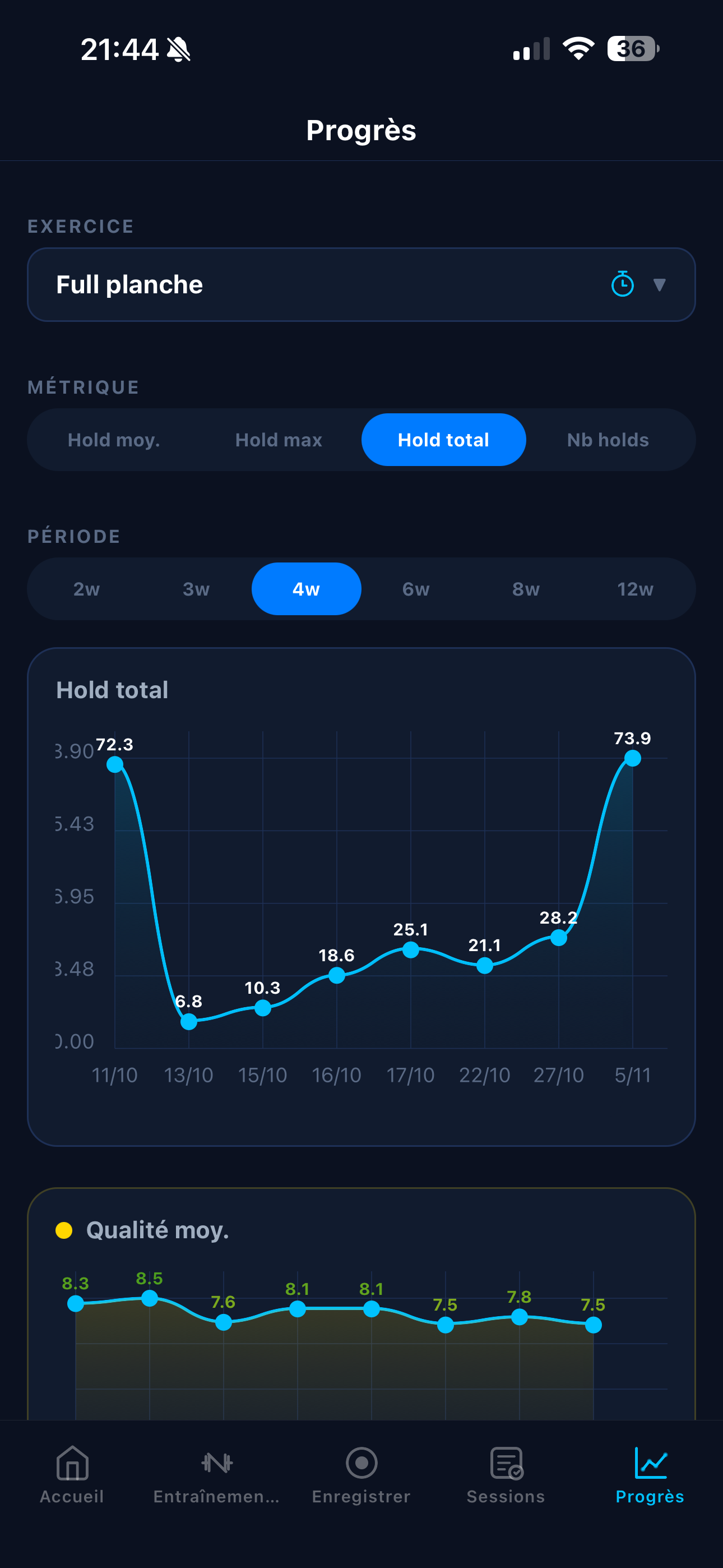
Source: the Calis League app.
2. An Invigorating Biological Effect All Day Long
An intense exercise activates the "fight or flight" system, the body's alert system. It's a bit like a dose of coffee: it gives you an invigorating, alert feeling that lasts throughout the day.
3. A Remedy Against Motivation Slumps
Fragmenting your sessions breaks down a training task that can seem painful on some days into "infinitesimal" tasks that are much easier to complete. The result: consistency becomes easier to achieve, and so do results.
Application Examples: Skill Learning
Handstand (and One Arm Handstand for Advanced Athletes)
The handstand is the textbook case for splitting your training into more, shorter sessions, in other words Grease The Groove. Spreading your attempts across the day helps you internalize and automate certain movement patterns, which smooths out and speeds up the automation that takes place in the brain as you learn the skill: stability through the fingers and elbows, optimal recruitment of the shoulder muscle fibers to hold your balance, and so on.
Learning the Planche
In lever movements (planche, front lever…), the natural fluctuations of your body weight throughout the day play a considerable role: your weight is never exactly the same fasting in the morning, after a meal or at the end of the day, and water retention or stomach content alone can make the same progression easier or harder. That's one of the real benefits of training several times a day: you get a smoothing effect across your training, because your progress no longer depends on a single time window, with its weight and freshness of the moment.
Put It Into Practice with Calis League
The best way to know whether GTG works for you is to try it and track your results. I invite you to try the Calis League app: log your sets throughout the day and visualize your progress, just like on the chart above.
Working on a skill (handstand, planche, front lever…)? Use the Expert Review feature: train with the live tracker then tap Expert Review, or upload a video from the Video Analyzer. I'll personally look at your skill and give you tips to correct it and adjust your routine.